In real estate, titles get thrown around loosely. Investor. Builder. Developer. General contractor. Sometimes people use the words interchangeably, but they describe very different businesses, skill sets, risks, and responsibilities.
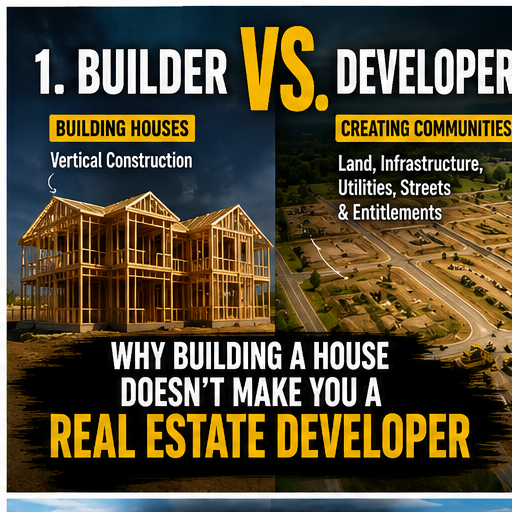
One of the biggest distinctions is between a home builder and a real estate developer. Building a beautiful home—even an expensive custom home—does not automatically make someone a land developer. The easiest way to understand the difference is to think about vertical construction versus horizontal construction.
A Builder Goes Vertical
A home builder takes a buildable lot and constructs the home that sits on it. That is vertical construction. The builder is coordinating everything required to take a set of architectural and engineering plans and turn them into a finished residence: foundation, framing, roofing, mechanical systems, insulation, drywall, cabinets, finishes, landscaping, inspections, and hundreds of details in between.
That is not simple work. A great custom builder needs strong systems, reliable vendors, construction knowledge, budgeting discipline, client communication, and the ability to solve problems every day. But the builder is typically starting with a parcel that can already support the home being constructed.
Even when a complicated custom lot requires major dirt work, retaining walls, grading, or engineering, that can still be part of the vertical home-building process. On one of our projects, we had roughly half a million dollars of dirt work, retaining walls, and site preparation before the house itself could move forward. That was substantial site work, but the project was still fundamentally a custom-home build.
A Developer Creates the Buildable Lots
A true land developer is operating one level earlier in the process.
Think raw land: trees, dirt, no streets, no sanitary sewer, no fire hydrants, no electrical distribution, and sometimes no practical way to serve the future homes at all. The developer’s job is to take that land through the engineering, entitlement, municipal, and construction process required to transform it into usable lots.
That can mean planning and constructing roads, installing storm drainage, extending water lines, creating sanitary sewer systems, coordinating electrical and communications infrastructure, installing fire hydrants, building retaining systems, and sometimes dealing with lift stations or other utility infrastructure. The developer may also have to work with cities, counties, utility districts, engineers, surveyors, attorneys, and multiple agencies before a single home foundation is poured.
That is horizontal construction. Before anyone can go vertical, the developer creates the platform that makes vertical construction possible.
Why the Difference Matters
The distinction matters because the financial model is different.
A custom builder is usually trying to build one home efficiently and profitably. A developer may be looking at dozens of future lots and asking a much larger question: How much money must be spent on the land and infrastructure before these lots can be sold or built on?
Suppose a developer purchases a tract, engineers it, installs the roads and utilities, and ends up with twenty finished lots. If ten of those lots can be sold for enough money to recover most or all of the original land and development cost, the remaining lots may carry an extremely low basis. Those remaining lots can potentially be sold, held, or used for vertical construction.
That is one reason development can create so much wealth. You are not just building a product. You are manufacturing buildable real estate.
But the upside comes with significantly more risk. Development often requires more cash, more time, more consultants, more government interaction, and more uncertainty before revenue arrives. A delay with engineering, utility capacity, drainage, entitlement, or municipal approvals can affect an entire project.
Buying a Teardown Is Not the Same Thing
This is where the language gets muddy.
If you buy an older house in an established neighborhood, tear it down, and build a new luxury home on the same lot, you may be a highly capable investor and home builder. But you did not create the neighborhood infrastructure. The road was there. The utility service existed. The parcel was already a legally recognized, buildable lot.
You developed a property in the everyday sense of the word, but that is different from land development as a business discipline.
The same applies when someone buys an already improved lot or a pad in an existing subdivision. There may still be meaningful site work, but the horizontal infrastructure has already been created by someone else.
Builders and Developers Need Each Other
None of this is about deciding which role is more impressive. Good builders and good developers solve different problems, and large real estate projects often need both.
The developer creates the lots. The builder creates the homes. Some companies do both, which can be extremely powerful because they participate in value creation on both sides of the equation.
For builders looking to expand, development can be a natural next step—but it should not be treated like simply building a bigger project. The learning curve includes civil engineering, utilities, municipalities, financing structures, phasing, infrastructure construction, and land economics.
Know Which Business You Are Actually In
The point is simple: use the title that matches the work.
If you build homes, own that. Building a high-quality custom home is a difficult and valuable skill. If you take raw land and create roads, utilities, infrastructure, and finished lots, you are operating as a real estate developer. If you do both, you have an integrated development and construction business.
Knowing the distinction makes you better at evaluating opportunities because it forces you to understand where value is actually being created.
The vertical side gets most of the attention because that is what people can see when the project is finished. But long before the kitchen, stone, windows, or framing ever show up, someone had to figure out how to turn dirt into a place where a house could legally and practically exist.
That is development.