When homeowners compare custom builders, they often focus on architecture, craftsmanship, schedule, and price per square foot. One question that deserves just as much attention is how the construction contract is structured.
Two of the most common approaches are cost-plus and fixed-price construction.
Neither method is automatically good or bad. They simply allocate risk, transparency, and potential profit differently between the homeowner and the builder.
Understanding that difference can prevent a lot of confusion during a custom-home project.
What Is a Cost-Plus Contract?
Cost plus is exactly what it sounds like.
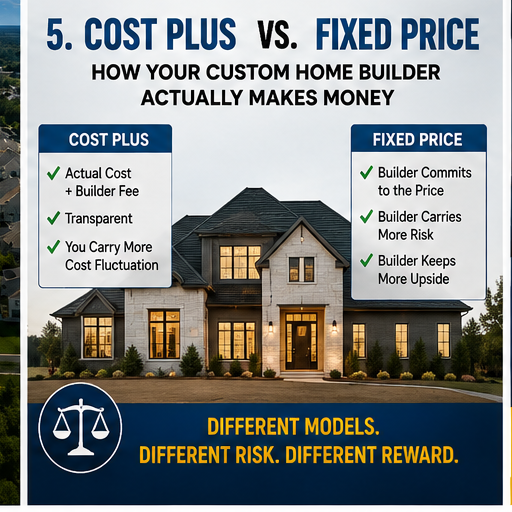
The builder establishes the expected cost to construct the home and then charges an agreed builder fee on top of those costs. If the project costs $1.5 million and the builder’s fee is 20 percent, the construction agreement is based on the actual project cost plus that fee.
The defining characteristic is transparency.
In a well-run cost-plus project, the homeowner can typically see bids, estimates, invoices, change orders, and the actual costs being incurred. Depending on the financing structure, the client or lender may also review or approve draws and invoices throughout construction.
That transparency is one reason we like cost plus for custom client builds.
The homeowner can see what the framing costs, what the landscaping costs, what the cabinets cost, and what is happening to the budget as the home evolves.
What Is a Fixed-Price Contract?
With a fixed-price contract, the builder agrees to deliver the defined scope of the project for a set price, subject to the specific terms, allowances, and change-order provisions in the agreement.
The client may see allowance amounts for items such as appliances, plumbing fixtures, lighting, or flooring, but the builder’s detailed cost structure is usually not presented in the same way as a cost-plus job.
If the builder prices framing at $200,000 and ultimately completes it for $150,000, the builder generally keeps that upside. If framing ends up costing $225,000 and the overage is not caused by a client change or covered by the contract, the builder may absorb the loss.
That is the central tradeoff.
In fixed price, the builder typically accepts more cost risk. In exchange, the builder also has more opportunity to earn additional margin through purchasing, estimating, and execution.
Why Fixed Price Can Produce Higher Builder Profit
Some homeowners hear that a builder can make more money on fixed price and assume something improper is happening.
That misses the point.
Profit is the compensation for risk, expertise, systems, capital, and execution.
If a builder commits to a fixed number, that builder has to know the project extremely well. A missed structural requirement, underestimated labor package, price increase, or scope mistake can come directly out of the builder’s margin.
Experienced builders who understand their costs can price that risk appropriately.
The better they estimate and execute, the more upside they may retain. The worse they estimate, the more of their own profit is exposed.
Why Cost Plus Can Feel More Collaborative
Cost plus works differently because the client can see the actual numbers.
If an appliance package increases, the cost is visible. If the homeowner chooses a more expensive stone, the budget moves accordingly. If a vendor price is lower than expected, the client can see that too.
This structure often works well on highly customized luxury homes because the project can continue changing throughout design and construction.
A client may start with one lighting package and later upgrade it. Cabinets can become more elaborate. Pools, landscaping, automation, and finish selections can expand as the home takes shape.
Trying to predict every one of those choices years in advance can be difficult.
Cost plus provides flexibility while keeping the financial relationship transparent.
The Homeowner Still Needs Budget Discipline
Transparency does not mean unlimited spending.
A cost-plus project should still have a detailed budget, clear allowances, regular reporting, and disciplined change management. The builder and client should know where the project stands throughout construction.
Otherwise, cost plus can become an excuse for sloppy budgeting.
The builder’s job is not merely to forward invoices. A professional builder should be forecasting, communicating, comparing costs with the budget, and warning the homeowner when decisions are pushing the project off track.
Allowances Matter in Both Structures
Whether the contract is cost plus or fixed price, allowances need to be realistic.
An allowance is essentially a placeholder for a category where the exact selection may not be finalized. Appliances are a common example.
If the contract includes a $40,000 appliance allowance and the homeowner chooses a $70,000 package, the additional $30,000 has to go somewhere. Under either contract structure, the client should understand how that overage will be handled.
Problems arise when allowances are intentionally set too low simply to make the initial contract price look attractive.
A realistic budget is more valuable than a low headline number.
Which Contract Is Better for a Custom Home?
The answer depends on the builder, the client, and the project.
Cost plus can be a great fit when the home is highly customized, selections are still evolving, and the homeowner values visibility into actual project costs.
Fixed price can be attractive when the scope is extremely well defined and the client values price certainty. It also works well for builders with deep historical cost data and systems that allow them to accurately price risk.
Neither contract replaces due diligence.
A poorly managed project can fail under either structure. A good builder should be able to clearly explain the agreement, fee, allowances, change-order process, invoicing, and how unexpected conditions are handled before construction begins.
Follow the Risk
The simplest way to understand the difference is to follow the risk.
Under cost plus, the client generally carries more of the direct cost movement while benefiting from transparency into actual expenses.
Under fixed price, the builder takes on more estimating and cost risk while preserving more upside if the project is delivered below the builder’s internal budget.
Once you understand that, the pricing model becomes much easier to evaluate.
The goal should not be to find the contract that sounds cheapest. The goal is to choose a builder and structure where expectations are clear, incentives are understood, and both sides know exactly how money will be handled.
On a multi-million-dollar custom home, that clarity is worth far more than a vague promise about the lowest price.