“What do you build for per square foot?”
It may be the most common pricing question in custom home construction—and one of the easiest numbers to misunderstand.
Clients want a simple benchmark. Builders want a fast way to evaluate plans. Investors want to compare opportunities. Cost per square foot is useful for all of those things, but only when you understand what the number actually includes.
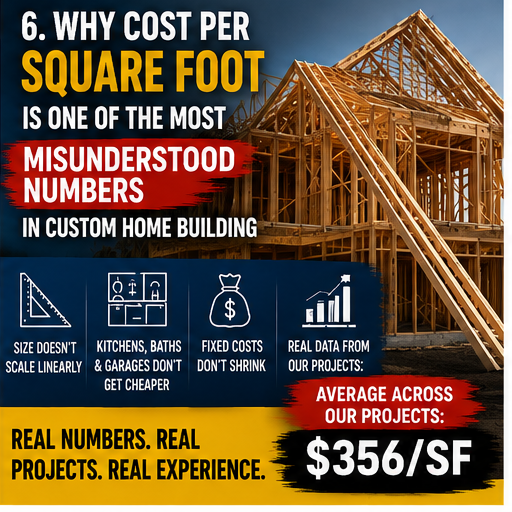
Our own historical project data makes the problem clear. When we looked across homes we have built and removed major non-house items such as pools, solar systems, and golf simulators, our average build cost was roughly $350 per square foot including builder fee. Some spec homes have landed closer to the high-$200s or low-$300s per square foot, while highly customized client homes can reach $400 to $500 per square foot or more.
Those ranges are not contradictions. They reflect different houses.
Square Footage Is the Denominator, Not the Scope
A 5,000-square-foot home and a 5,000-square-foot home can have completely different construction budgets.
One may have a simple rectangular footprint, standard roof geometry, modest glass, four bedrooms, and straightforward finishes. The other may have complex rooflines, large steel openings, extensive stone, custom windows, five bathrooms, a prep kitchen, wine room, elevator, expensive appliances, detailed millwork, and a six-car garage.
The heated square footage might be identical.
The cost is not.
That is because price per square foot is simply total cost divided by a square-foot measurement. It does not explain what is contained inside the numerator.
Smaller Homes Can Cost More Per Square Foot
This surprises a lot of people.
Suppose two homes both have four bedrooms and four bathrooms. One is 4,200 square feet and the other is 5,500 square feet.
The larger home has more floor area, but many of the expensive components do not increase proportionally.
Both homes may still have one kitchen. Both need four bathrooms. Both need appliances, plumbing fixtures, mechanical equipment, electrical panels, cabinets, countertops, doors, and a long list of fixed systems.
The additional 1,300 square feet in the larger home may consist largely of relatively less expensive spaces such as larger bedrooms, wider hallways, a bigger living area, or additional open floor space.
When the cost is divided by more square feet, the cost per square foot can fall even though the total home costs more.
That is why smaller luxury homes can show surprisingly high per-square-foot numbers.
Kitchens and Bathrooms Move the Number
Not all square footage costs the same.
A 200-square-foot bedroom is mostly framing, drywall, flooring, electrical, paint, and trim.
A 200-square-foot kitchen can include cabinetry, countertops, plumbing, appliances, gas, ventilation, specialty lighting, tile or stone, electrical circuits, hardware, and expensive fixtures.
Bathrooms work the same way. A luxury bathroom can contain waterproofing, tile, glass, cabinets, countertops, plumbing fixtures, electrical, mirrors, lighting, and specialty features in a relatively small area.
This is why bedroom and bathroom count matters when trying to estimate a house from historical data.
Garages Create Another Distortion
Garages are a perfect example of why a single price-per-square-foot number can be misleading.
A home might be described as 4,000 square feet of living area but include a six-car garage, boat storage, large covered patios, and substantial area under roof that is not counted in the advertised living square footage.
Those spaces still cost money.
They need foundation, framing, roof, electrical, doors, finishes, and sometimes HVAC or specialty equipment. If those costs are included in the construction total but the garage area is excluded from the square-foot denominator, the reported cost per living square foot rises.
The number looks expensive even though the house may simply contain much more building than the living-area figure suggests.
Luxury Allowances Can Blow Up Comparisons
Another source of confusion is client selection.
One homeowner may choose a $25,000 appliance package. Another may choose $70,000 or more. One may use straightforward decorative lighting while another spends six figures on lighting, shades, AV, and automation.
If those costs are included in the build price, the price per square foot rises.
That does not necessarily mean the builder’s framing, concrete, drywall, or labor costs are unusually high. It may mean the house contains expensive owner-selected components.
That is why builders should be careful when publicly quoting a single number without explaining what is included.
Historical Data Is More Valuable Than Internet Opinions
The best way to estimate future projects is to build a database from actual completed projects.
We track what our homes really cost and break major categories down by square foot and by percentage of the project. Over time, that gives us a much better estimating tool than simply saying, “Luxury homes cost X per square foot.”
If someone sends us plans, we can look at square footage, bedrooms, bathrooms, area under roof, garage size, complexity, and expected finish level and compare those variables with real houses we have already built.
It is still an estimate. Construction pricing changes and every lot and design has unique conditions. But historical data gives you a defensible starting point.
Use Cost Per Square Foot as a Screening Tool
Cost per square foot is valuable early in a project.
It can tell you whether a concept is generally aligned with the budget. If someone wants a highly customized 8,000-square-foot luxury home but the available construction budget implies a number dramatically below your historical range, you know immediately that expectations need to be adjusted.
What it should not do is replace detailed estimating.
Once the plans develop, the builder needs actual quantities, real vendor pricing, allowances, engineering, site information, and a clear scope.
Ask What the Number Includes
Whenever someone quotes a construction cost per square foot, ask follow-up questions.
Does it include the builder fee? Appliances? Site work? Landscaping? Pool? Architectural fees? Engineering? Flatwork? Covered patios? Garages? Smart-home systems? Utility connections?
Without that context, two builders can quote radically different numbers while actually pricing very similar work.
Cost per square foot is not meaningless. It is simply incomplete.
Use it as a benchmark, not a promise.
The more detailed your historical data becomes, the more useful the number becomes. But the real question is never just, “What do you build for per square foot?”
The better question is, “What kind of house are we actually trying to build, and what is included in that number?”