A cheap lot can be one of the most expensive mistakes in residential real estate investing.
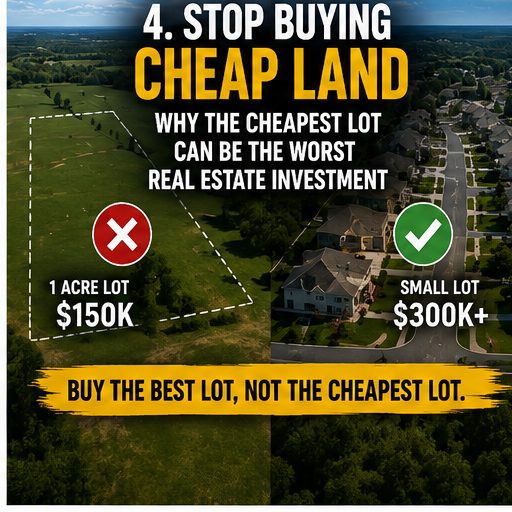
That sounds backward. Investors naturally want to buy land for the lowest possible price. If one acre costs $150,000 in a more rural area and a small infill lot costs $300,000 closer to an established neighborhood, the acre can look like the obvious deal.
But the price of the land is only one variable. The better question is: What will the finished home be worth on that land?
That is where many deals fall apart.
Cheap Dirt Does Not Guarantee Cheap Basis
Imagine you buy a one-acre lot for $175,000. You build a 4,000-square-foot house for $185 per square foot. At first glance, the numbers may feel attractive.
But construction cost per square foot does not include every cost of the deal. You still have design, engineering, permits, site work, financing, insurance, utilities, holding costs, commissions, closing costs, and potentially a long list of upgrades or unexpected conditions.
Now suppose comparable homes in that area are selling for only $230 to $250 per square foot.
The spread between your total basis and your finished value can disappear quickly.
You may have bought cheap land, but you did not buy enough resale value.
Underwrite the Exit Before You Fall in Love With the Lot
The most important number is not what you pay for the dirt. It is the realistic value of the finished product.
Before buying a lot, work backward from the exit.
What do comparable finished homes actually sell for? How large are they? How new are they? What lot sizes are buyers paying premiums for? What finishes are required to achieve the top of the market? How long are the best comps sitting before they sell?
Then compare that expected sale price with the full project cost.
A basic underwriting model should include the lot, construction, soft costs, site work, financing and interest, builder fee or overhead, selling expenses, contingency, and realistic market value.
If the margin only works because you assume a record-breaking sale price, it probably does not work.
Bigger Land Is Not Always Better
Acreage is emotionally attractive. People imagine privacy, trees, a larger backyard, a shop, a pool, and space between neighbors.
For a personal residence, those benefits may justify the purchase even if the investment return is not optimized.
But an investment property has a different job. It needs to produce a return.
In some DFW submarkets, larger lots can be relatively inexpensive because the surrounding homes trade at lower prices per square foot. You may be able to buy much more land, but if the finished home cannot command a strong enough sale price, the economics are limited.
Meanwhile, an older established area such as Grapevine or Keller may offer smaller infill lots at a higher land price but substantially stronger finished-home values. You are paying more for the dirt because the location supports a more valuable exit.
That can be a much better investment.
Price Per Square Foot Matters on Both Sides
Investors often obsess over build cost per square foot while ignoring sale price per square foot.
Both matter.
If you can build efficiently at $200 per square foot but the market only supports $240 per square foot, the spread is not automatically $40. The land and every other project cost still have to come out of that difference.
On the other hand, paying more for a lot in a neighborhood where new construction sells for a much stronger number can create far more room in the deal.
This is why a $300,000 small lot can outperform a $150,000 large lot.
The expensive lot may be attached to a better economic engine.
Separate Lifestyle Decisions From Investment Decisions
One of the hardest things for buyers to do is separate what they personally want from what makes the strongest investment.
Maybe you want one or two acres. There is nothing wrong with that. But if the objective is to build a primary residence, live in it for several years, and create significant equity, the best first move may not look like your dream property.
You may need to build on the smaller lot in the better resale location, create equity, and use that equity later to move into the acreage property you really want.
That is not settling. It is sequencing.
Real estate wealth is often built by making the best financial move available now so you have more choices later.
Do Not Assume Appreciation Will Save a Weak Deal
DFW has experienced tremendous growth, and long-term appreciation can make mediocre decisions look smart after enough time.
But appreciation should be upside, not the only thing protecting the project.
Interest rates change. Buyer demand changes. Construction prices move. Neighborhoods grow at different speeds. If your deal requires the market to rise significantly just to break even, you are speculating rather than underwriting.
A strong deal should make sense with today’s defensible numbers.
The Lot Is a Component, Not the Investment
When I evaluate land, I am not simply asking whether the lot is cheap. I am asking what that specific parcel allows me to create.
Can I build the right size house? Does the architecture fit the neighborhood? Are the comps strong enough? Is the lot difficult to develop? Are utilities available? Does the site require retaining walls, major grading, septic, unusual foundation work, or expensive drainage solutions?
Two lots with the same purchase price can have dramatically different economics.
The dirt is not the deal. The entire project is the deal.
Buy the Spread, Not the Acreage
The best investors learn to stop shopping with their emotions and start shopping with an underwriting model.
A beautiful one-acre lot for $150,000 may be exactly right for your family. But if your goal is investment return, compare it with the smaller lot that costs more and supports a much higher-value finished home.
Sometimes the lot that feels expensive creates the cheapest basis relative to its exit value.
And sometimes the cheap dirt is cheap for a reason.
Before you buy land, do the math all the way through the sale. You are not trying to win on the purchase price.
You are trying to win on the spread between everything you put into the property and what the market will pay you when you are done.