Real estate investing is filled with success stories. Scroll through social media long enough and you’ll see luxury cars, vacations, six-figure profit screenshots, and claims that building investment homes can become an almost passive source of income.
What you see far less often is what happens between buying the land and collecting the profit.
On a recent episode of the Dallas Builders Club Podcast, we sat down with Austin, a first-time home builder who had just completed his first investment property after going through another real estate coaching program. He accomplished something most people never do: he actually took action, secured financing, bought a lot, built a home, and brought it to market.
But the experience also exposed some important lessons about real estate investing—and, more importantly, what people should look for when choosing a home building coach or real estate investing mentor.
Taking Action Matters, But Guidance Matters Too
One thing deserves to be said upfront: Austin did what thousands of aspiring investors never do.
He started.
He had approximately $20,000 in savings and was willing to invest that money into learning how to become a real estate developer. He found creative ways to access additional capital and ultimately completed a house in roughly seven months.
That willingness to take calculated risks is an important characteristic of successful entrepreneurs.
At the same time, taking action without understanding your risks can become extremely expensive.
Good coaching shouldn’t eliminate risk—nothing can. Instead, a great home building coach should help you understand the risks before you take them.
That distinction matters.
Your Profit Is Often Determined Before Construction Begins
One of Austin’s biggest lessons had nothing to do with framing, plumbing, cabinets, or construction.
It was the dirt.
When initially analyzing his deal, he focused heavily on active and pending listings rather than putting enough emphasis on actual sold comparable properties.
That mistake affected the economics of the entire project.
In real estate development, you can execute construction extremely well and still have a bad investment if you bought the land incorrectly.
Before purchasing a property, you should understand:
- Realistic sold comparable values
- Expected construction costs
- Site-development expenses
- Financing and loan fees
- Realtor commissions
- Property taxes
- Insurance
- Interest and carrying costs
- Expected days on market
- Potential price reductions
- Contingencies for unexpected expenses
And most importantly, you need to understand your net profit, not simply the attractive gross-profit number someone showed you on Instagram.
Austin originally expected significantly larger returns. With the completed house still on the market and carrying costs continuing to accumulate, he estimated that the project might ultimately generate roughly $40,000.
That’s still a completed deal and an incredible education—but it’s very different from the easy six-figure profits people are often sold.
Stress Test Every Real Estate Deal
One of the most important concepts for new investors is stress testing.
Don’t underwrite your deal assuming everything goes perfectly.
Run at least three scenarios.
Best case: Construction stays on budget, the project finishes on schedule, and the house sells quickly.
Realistic case: Construction has normal delays, some expenses exceed the budget, and the house takes time to sell.
Worst case: Construction runs late, interest accumulates, unexpected site costs appear, the house sits on the market, and you need to reduce the price.
If your project only works in the best-case scenario, you probably don’t have a good deal.
We’ve learned this ourselves.
On one project, unexpected civil and site-development requirements eventually revealed approximately $400,000 in dirt work. The deal had to be restructured and redesigned.
We’ve experienced unexpected material price increases, utility delays, permitting issues, theft, contractor problems, and projects that simply didn’t perform the way we originally expected.
Experience teaches you to look for these problems before they become expensive.
And that’s exactly what a good coach should help you do.
Home Building Is Not Completely Passive
Another major misconception Austin encountered was the idea that building an investment property would be largely passive.
It isn’t—especially your first time.
When you’re new, you don’t know what you don’t know.
You don’t know when utilities should be scheduled.
You don’t know when your next contractor needs to be ready.
You may not know how to read construction plans.
You don’t know which questions your electrician, plumber, framer, or cabinet contractor is going to ask.
Austin experienced a four-week driveway delay because utility companies weren’t scheduled far enough in advance.
An experienced builder recognizes those potential bottlenecks and starts scheduling weeks or months ahead.
Eventually, home building can become significantly more efficient.
Once you have dependable contractors, understand construction sequencing, know your municipalities, and have systems in place, managing one investment property might require dramatically less time.
But you have to earn that efficiency through knowledge and experience.
Don’t Choose a Coach Based on Their Lifestyle
This may be the biggest lesson from the entire conversation.
Austin openly admitted that one reason he selected his original mentor was because he was attracted to the lifestyle being marketed.
The vacations.
The flashy possessions.
The image of what successful real estate investing could provide.
After completing a real project, his perspective changed.
When he found Dallas Builders Club, what attracted him wasn’t a Lamborghini or vacation photo.
It was the houses.
The construction sites.
The processes.
The finished product.
That’s an important distinction when evaluating any home building coaching program.
Don’t hire someone because you want their lifestyle. Hire someone because you want their knowledge.
Ask yourself:
Does this person actually do what they’re teaching?
Are they actively building homes?
Can they analyze a real deal?
Can they identify problems with a lot?
Do they understand financing?
Can they read plans?
Do they understand construction sequencing?
Do they understand municipalities and utilities?
Can they help you when something goes wrong?
And perhaps most importantly:
Are they primarily running a coaching company—or are they running the business they’re coaching you how to build?
Look for Systems, Not Motivation
Motivation is useful.
Systems are more valuable.
Austin told us that one of the biggest things he wanted was surprisingly simple:
A detailed, step-by-step checklist.
When you’re staring at an empty piece of dirt for the first time, someone telling you to “go build the house” doesn’t help very much.
You need to know what happens first.
Then what happens next.
Then who needs to be scheduled.
Then what needs to happen before that contractor arrives.
A strong coaching program should provide actual implementation tools: underwriting models, construction budgets, permitting guidance, vendor strategy, plan-reading education, deal analysis, construction sequencing, exit strategies, and clear action items.
Knowledge becomes much more powerful when someone organizes it into a process you can actually follow.
Access to Your Coach Matters
Construction problems don’t conveniently happen during scheduled Zoom calls.
Sometimes you discover a problem on your job site Tuesday morning and need an answer Tuesday morning—not during next week’s group coaching call.
That doesn’t mean a successful coach needs to personally answer every student 24 hours a day.
But a coaching organization needs a system for getting students timely answers.
If a program grows, its support infrastructure has to grow with it.
Coaching is only valuable if students can access the knowledge when they actually need it.
Find Someone Who Will Tell You Not to Do the Deal
Perhaps the most valuable thing a coach can tell you is:
Don’t buy it.
We recently reviewed a potential lot with one of our students. To him and his wife, it looked fantastic.
Beautiful established neighborhood.
Large lot.
Great location.
Within seconds, however, we noticed issues experience had trained us to see: extensive trees requiring removal, significant fill requirements, easements, nearby infrastructure, and potential resale concerns.
Our job isn’t to convince someone to do a deal.
It’s to help them see the things they may not recognize yet.
A coach who agrees with every idea isn’t necessarily coaching you.
Sometimes protecting your money means challenging your assumptions.
The Right Coach Helps You Become a Builder
The goal shouldn’t be to remain dependent on a coach forever.
The goal should be to develop your own judgment.
Austin completed his first house. During the process, contractors taught him things, mistakes taught him things, the market taught him things, and experience taught him things.
His second project will not feel like his first.
That’s progress.
Real estate development can create substantial wealth. Home building can become an incredible business. But neither happens because someone sold you a dream.
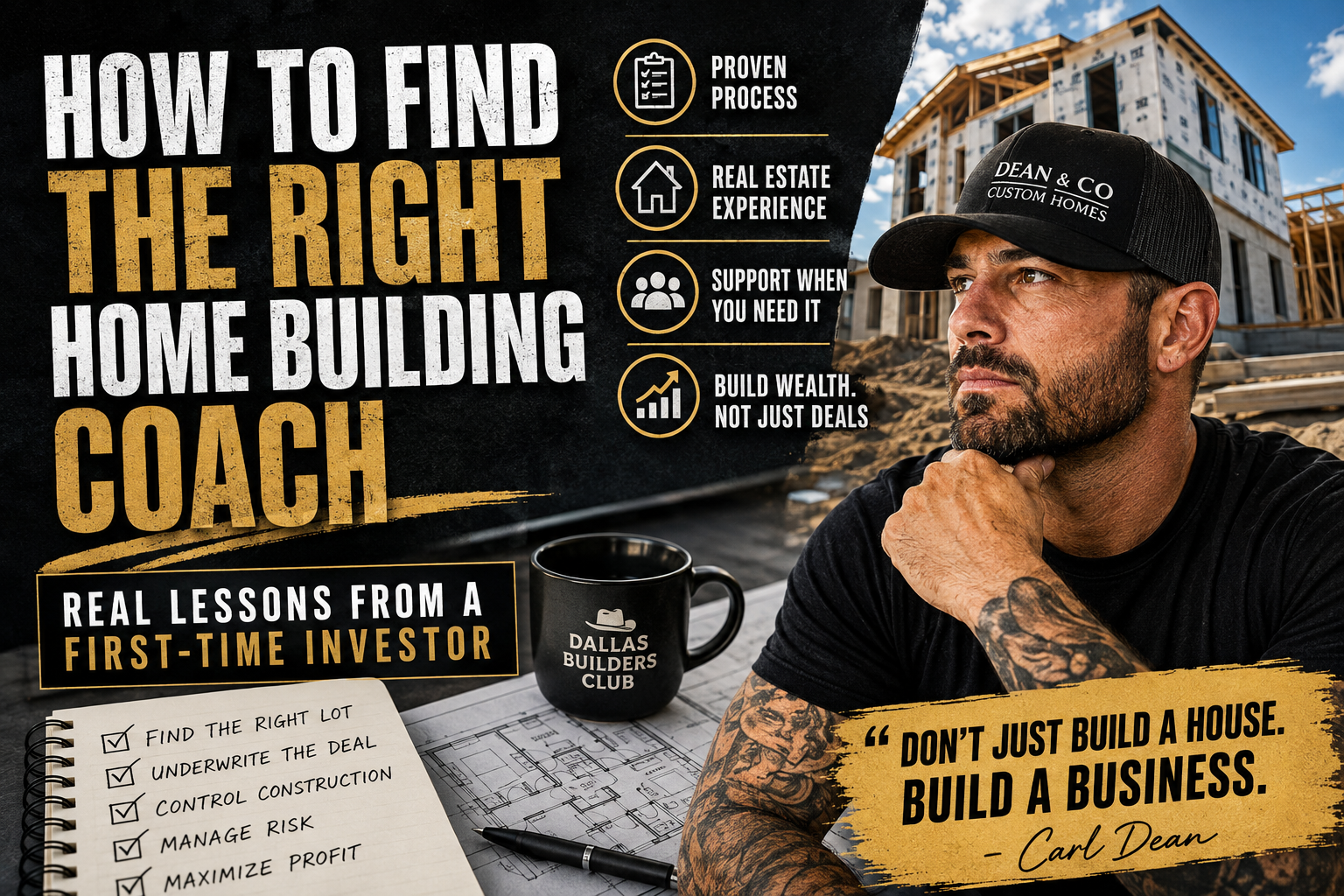
It happens because you learn how to find the right property, underwrite the deal, understand your downside, control construction, solve problems, manage your capital, and execute a repeatable system.
So, if you’re looking for a home building coach, don’t start by asking:
“How successful does this person’s life look?”
Ask something much more valuable:
“Has this person successfully done what I’m trying to do—and can they teach me how to do it?”
That answer could save you far more than the price of any coaching program.