Luxury-home budgets can get out of control quickly because almost every category has a premium version.
You can upgrade the windows, appliances, lighting controls, plumbing fixtures, audio system, flooring, cabinetry, hardware, landscaping, pool equipment, security, and dozens of other components. Individually, each upgrade may sound reasonable. Collectively, they can add hundreds of thousands of dollars to a project.
So where should you spend, and where can you save?
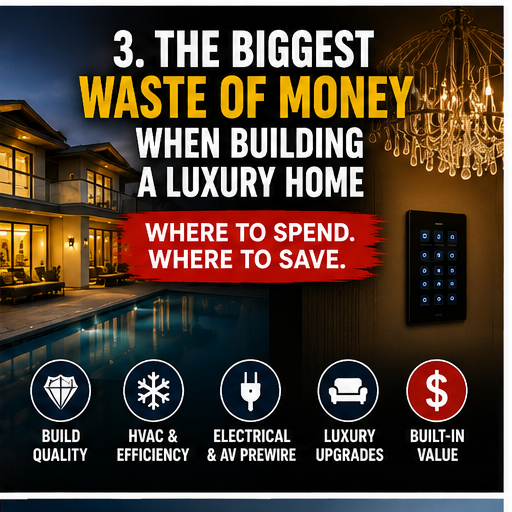
If I were looking for one of the first major line items to question in my own luxury-home budget, I would look hard at an extremely elaborate whole-home automation and lighting-control package.
Expensive Does Not Always Mean Essential
Systems such as Lutron can be impressive. You can create lighting scenes, control shades, consolidate switches, automate rooms, and operate a large portion of the home from keypads or mobile devices.
In the right house and for the right homeowner, that can be a great feature.
But it can also be expensive—sometimes extremely expensive. On large luxury homes, sophisticated AV, lighting, shades, and automation packages can climb well into six figures.
The question is not whether the technology is cool. The question is whether it creates enough value for you to justify the cost and long-term complexity.
For me personally, I am perfectly capable of walking over and flipping a switch. If I had an extra $100,000 to deploy in a custom build, whole-home lighting automation probably would not be at the top of my list.
Start With Infrastructure
There is an important distinction between good infrastructure and expensive gadgets.
When we budget a custom home, I want the house properly prepared for technology. That means the electrical and low-voltage infrastructure should be planned correctly. Prewire the locations that matter. Create a proper AV equipment location. Run the data cabling. Plan for televisions, cameras, wireless access points, speakers, shades, pool equipment, and other systems the homeowner may want.
That preparation is relatively inexpensive compared with a fully integrated automation package, and it preserves options.
A homeowner can upgrade equipment later. Opening finished walls to add wiring later is far more disruptive.
That is why I would rather build a strong foundation for technology than force every possible technology upgrade into the base construction budget.
Spend First on the Things That Are Hard to Change
If you are trying to prioritize a luxury-home budget, start with the components that affect the performance and longevity of the house.
Foundation and structural design matter. Waterproofing matters. The building envelope matters. Quality sheathing, insulation, HVAC design, drainage, and ventilation matter. Window installation matters. Roof details matter.
These items may not get the biggest reaction when friends walk through the house, but they determine whether the house performs well five, ten, or twenty years from now.
They are also expensive to correct later.
A decorative light fixture can be replaced in an afternoon. Fixing a bad drainage condition, undersized HVAC system, poorly designed envelope, or structural issue is a very different problem.
That does not mean every homeowner needs the most expensive version of every building material. It means the invisible parts of the house deserve serious consideration before the visible upgrades consume the budget.
Know Which Upgrades Actually Affect Resale
The conversation changes when you are building at very high price points.
Once a home moves into the $4 million-plus range, buyers may expect a certain level of automation, AV capability, motorized shades, lighting controls, and other premium features. In that segment, technology can contribute to the wow factor and help the house feel consistent with its competition.
But even then, the system should fit the market and the homeowner.
A feature can be impressive during a showing and frustrating six months later if the owner cannot remember how to operate it. We have all been in a house where turning on the television requires a lesson. That is not luxury. Luxury should feel effortless.
Sometimes a simpler combination of familiar systems—such as Sonos for audio, straightforward smart controls, and well-planned conventional switching—can deliver most of the benefit with far less complexity.
Put Money Where You Personally Experience It
Luxury is subjective.
One homeowner may never care about smart lighting but use a $70,000 appliance package every day. Another may care deeply about automated shades because the house has huge expanses of glass. Someone else may spend heavily on a golf simulator, outdoor kitchen, wine room, gym, or pool because those spaces are central to how the family lives.
That is the right way to think about upgrades.
Do not spend money simply because another luxury home has the feature. Spend because the feature improves your experience or because the market clearly expects it.
Builders Should Separate Base Construction From Luxury Add-Ons
This matters from a pricing standpoint too.
If a builder automatically places a $50,000 to $100,000 automation package into the base budget, the advertised cost per square foot immediately climbs. That can make the home appear more expensive to build even though much of the increase is elective technology.
A better approach is to clearly identify the baseline infrastructure and separate major discretionary upgrades. The client then understands what the home itself costs and what the optional luxury package costs.
Transparency makes budget conversations much easier.
The Goal Is Not to Build Cheap
Saving money on a luxury home does not mean cutting corners.
The goal is to avoid spending heavily on things you do not value while protecting the parts of the home that you cannot easily change later.
If the budget is unlimited, go as far as you want. But most people—even wealthy homeowners—still have a number in mind. When you start making tradeoffs, prioritize structure, performance, comfort, durability, and infrastructure first. Then spend aggressively on the finishes and technology that genuinely improve your life.
A luxury home should not be a collection of expensive features. It should be a well-built house where the money was spent intentionally.
Sometimes the most sophisticated decision is knowing which upgrade you simply do not need.